Last time, I introduced you to a creature of the Fair Folk, the Pooka. Today I want to tell you about a mythical being that might not be part of the Fair Folk in Celtic mythology, but fascinating nonetheless.
The etymology of the faoladh
First of, even after countless hours of research online, I have no definitive answer to the pronunciation of faoladh. In the Foclóir Poca dictionary for Irish, I found the following entries:
- faolchú ‘fi:l,xu – wild dog, wolf
- adh a – prefix meaning very (Note: it is just my guess that the second syllable in faoladh is related to this word; I found no actual proof in my dictionary or online)
So that settles the pronunciation of faoladh as FILa right? Well, no. On teanglann.ie (an online Irish-English dictionary), the pronunciation of faolchú sounds more like ‘fwi:l,xu, which would mean that faoladh could also be pronounced as FWILa. I’ve decided to stick with the latter.
The faoladh (read: FWILa) of Irish mythology
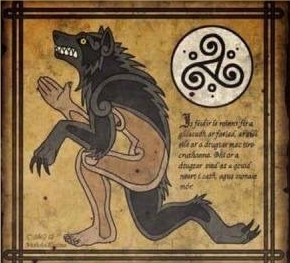
The Grey wolf populated the Irish countryside until the year of 1786, when the last of its kind were presumably killed. Up until their extinction, wolves roamed the land in great numbers, which gave rise to many stories in Irish folklore. However, the Irish faoladh isn’t quite like other werewolves. It is not a cursed being that is forced to turn into a bloodthirsty monster each full moon. No, the faoladh is a man or woman that can shapeshift into a wolf and serves as a protector and guardian of others.
The Werewolves of Ossory
In his 12th century work, the Topographia Hibernica, Giraldus Cambrenis tells a story of a priest who was approached by a faoladh to administer last rites to its dying mate. The faoladh told the priest that they were natives of Ossory, and an ancient curse had forced them into their wolf form. The faoladh explained that the curse forced a man and a woman to be exiled from their homes in Ossory and transformed into wolves every seven years.
There are two of us, a man and a woman, natives of Ossory, who through the curse of one Natalis, saint and abbot, are compelled every seven years to put off the human form and depart from the dwellings of men. Quitting entirely the human form, we assume that of wolves. At the end of the seven years, if they chance to survive, two others being substituted in their places, they return to their country and their former shape. And now, she who is my partner in this visitation lies dangerously sick not inspired by divine charity, to give her the consolations of your priestly office.
In a different medieval Irish work called Cóir Anmann, another type of werewolf is associated with the kings of Ossory: Laighnech Fáelad. These were described as vicious werewolf warriors, and they would fight alongside any king who was willing to pay them for their service with the flesh of newborns.
The faoladhs who inhabit my books
In my Crown of Tír na nÓg trilogy, the faoladhs play a very minor role. Kayla first encounters them in Seelie Princess.
A series of cries tore from a group of girls. Some pointed fingers. Kayla whirled around in time to see a man transform in midair. He landed on four paws, his tail whipping as he disappeared in the crowd.
Kayla gasped. “Werewolves!”
Another wolf came chasing after the first, its gray fur looking silver in the moonlight. Their howls sliced through the air.
“Not quite,” Nooa said. “They are faoladhs.”
“What now?” Kayla looked at the spot where the wolf had transformed, then back at Nooa.
“Shapeshifters.” He lowered his dagger an inch. “They are on our side.”
Later on in the story, Kayla learns that most faoladhs that live in Tír na nÓg reside in Faosor, a settlement in the Dark Forest. However, many faoladhs have left the faerie realm to build a live in the mortal world.
When Deirdre spoke, it wasn’t personal stories but ones of Tír na nÓg. She told Kayla of the merrows who lived on the Isle of Llyr and the faoladhs who roamed the north of Tír na nÓg. “Their home is Faosor,” Deirdre said. “Though you will not find many of them living there. Most are scattered throughout the mortal world.”
In Unseelie Queen, Fay witnesses a lot of hostility between the original pack of faoladhs and the ones that migrated to the mortal world.
“Seems there’s a lot of history between the different packs of faoladhs,” Fay noted.
Brógán cast his gaze to the ground. “Sadly, yes. In the beginning, all faoladhs lived in Faosor, but over time more and more left to roam the mortal world. My ancestors saw no harm in that. In fact, they encouraged young faoladhs to travel to the human realm and act as their protectors.”
“Then how come you are at odds with your own people?” Nooa asked.
“The same reason you are at odds with yours,” Brógán said. “Disagreement on how our packs should be led. We have always bowed to the Seelie King or Queen, but some faoladhs don’t want to be bound to anyone other than their pack.”
While the faoladhs might not be featured heavily in my Crown of Tír na nÓg trilogy, they are going to be the central characters for my upcoming project. From the moment that I learned about the Irish faoladh, I was deeply fascinated by the concept of a benign and kind-hearted werewolf, who was viewed as a protector rather than a monster. I can’t wait to delve even deeper into their lore.
Last Updated: November 22, 2023
If you are interested to learn more about this wonderful creature, you might want to check out these blog posts:
- Irish Werewolves by earthandstarryheaven
- The Scottish wulver and Irish faoladh in folklore by folklorethursday
Previous #FaerieFriday posts:
 Sarah Tanzmann
Leave a comment