During my research for my Crown of Tír na nÓg trilogy, I learned that the term ‘faerie’ does not refer to one individual type of being, but rather encompasses a whole variety of beings. In Celtic mythology there are many ways to categorize faeries, for example into Trooping Faeries or Solitary Faeries. But one categorization that has intrigued me from the beginning was the Scottish notion of a Seelie and an Unseelie Court.
[I]n Scottish legends the faeries are often divided into the Seelie Court and the Unseelie Court. The Seelie Court is comprised of the good, kind fairies, while the outright evil faeries tend to belong to the Unseelie Court (Briggs 1976: 222). These courts were not seen as very confining: the faeries of the Seelie Court could be violent when angered, while the […] members of the Unseelie Court could sometimes just have fun in non-lethal ways. (Faerie Folklore in Medieval Tales – An Introduction by Mika Loponen)
Beware: Seelies can be just as treacherous as Unseelies. The distinction, although implied, is not light vs. dark, good vs. evil. All of the Fair Folk lack moral sense and are incapable of understanding human emotions; the Unseelies’ methods might just be a bit more savage.
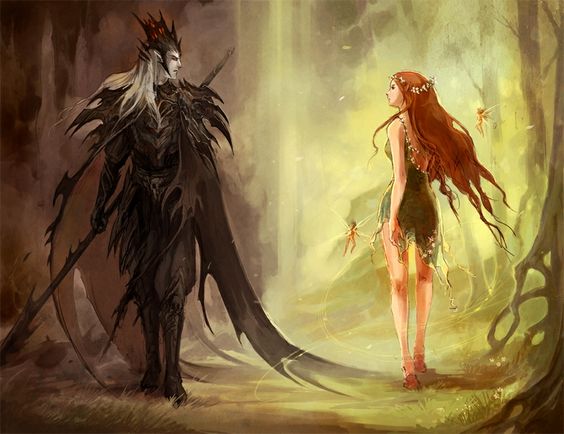
The Seelies and Unseelies who inhabit my books’ world
The first time I came across this distinction of Seelie vs. Unseelie was actually in a fictional novel. In the Mortal Instruments by Cassandra Clare, faeries are divided into two courts, and that idea fascinated me the moment I learned about it. But I wondered: Why were there two courts? Did they used to be one? What divided them? The beauty of story-telling is that we can make up our own answers. And so I went ahead and wrote The King’s Daughters, the first conflict between Seelies and Unseelies in my fictional world of Tír na Óg.
That conflict then carries on into my Crown of Tír na nÓg trilogy and is a central part of the story. In my interpretation, the two courts did in fact use to be one. But one of the king’s daughters turned on him and defected from the court, creating her own instead. The two courts went into battle, which the newly established Unseelie faeries lost. After that, they disappeared, but rumors remained. My trilogy’s main character, Kayla, first learns about this in Seelie Princess.
“There’s never been an official statement, no remark in the history books about the events. All that remains are murmurs and whispers, about a group of faeries unlike us Seelies which is hiding in Tír na nÓg, waiting to strike again. People call them Unseelies and fear their name.”
Kayla shuddered. “And there’s no way to find them? I mean, they’re your people, right?”
“We’ve searched all of Tír na nÓg and some parts of the mortal world, too. But they’re no longer our people. They’re not just some Wild Fae who decided to live away from home. They’re no longer bound to us.”
“Because they left the Seelie Court?” Kayla asked.
“They didn’t leave. They betrayed us. We don’t know what happened to Titania’s followers that they couldn’t enter the Seelie Court anymore, but there are some theories.”
“It’s in the blood,” Fay said. “It has to be.”
“I agree,” Maeve said. “Whatever Titania did to them, it changed their entire being. One could even say they’re a different kind of faeries now. The opposite of Seelie.”
Kayla couldn’t imagine how it could be possible to change someone’s blood. But that theory at least explained how the name Unseelie had emerged. The Seelies thought of them as something unworthy, something lesser.
In the two sequels to Seelie Princess, I continue to explore who the Unseelies truly are and why they defected from the Seelie Court in the first place. The Unseelies may be painted as the dark and evil counterpart to the Seelies, but there’s a story behind that. Things are never black or white, and that’s one lesson Kayla has to learn.
Previous #FaerieFriday posts:
 Sarah Tanzmann
Leave a comment